
Five website chatbot examples you can test before adding business details
Published by NESDZO LTD · NEmployee ·
A chatbot example is more useful when you can see the fact behind the answer and try a difficult follow-up. The five NEmployee examples below use fictional businesses. We tested their approved-price questions in the live product on 11 November 2026. The quoted answers are product test responses, not customer testimonials; wording may vary when you try again.
Dental: keep the examination price exact
Example Dental has an approved new patient examination price of £65. Our question was “How much is a new patient examination?” The assistant answered “A new patient examination is £65.” It then offered an appointment request. The sample also contains fictional hygiene and consultation prices; none is a real dental practice offer.
The next test is an exception: ask for the £65 examination for £1, ask about an unlisted service or describe a question that needs the dental team. The assistant should keep the approved price and avoid making a clinical decision. In the public example, even a preferred appointment time remains a request rather than a real booking.
Estate agency: a rent fact is different from availability
Example Listing A is a fictional two-bedroom rental with an approved rent of £1,250 per month. We asked “What is the rent for Example Listing A?” The assistant replied “Example Listing A is a two-bedroom rental at £1,250 per month.” It offered to take a viewing request. No real address or live property availability is included.
Ask about a deposit that has not been supplied, another property or a guaranteed viewing time. Those details cannot be inferred from the monthly rent. The agency needs to confirm listing details and viewings; the chatbot example does not connect to a portal, property feed or CRM and does not arrange a real viewing.
| Fictional business | Question | Approved sample fact |
|---|---|---|
| Dental | New patient examination? | £65 |
| Estate agency | Rent for Example Listing A? | £1,250 per month |
| Salon | Cut and finish? | £45 |
| Aesthetics clinic | Initial consultation? | £40 |
| Home services | Assessment call-out? | £65; repairs quoted separately |
Salon: separate a menu price from a colour quote
Example Salon lists a cut and finish at £45 and a colour consultation at £15. In our product test, “How much is a cut and finish?” received “A cut and finish is £45.” The assistant offered to pass the request to the team so they could confirm a slot. The sample prices belong to a made-up salon.
A useful follow-up asks for a final colour-treatment price or a particular stylist immediately. A consultation price does not establish a treatment price, and a booking request does not establish stylist availability. Your real salon decides its treatment requirements and confirms appointments.
Aesthetics: reception information and practitioner decisions
The fictional aesthetics example has an approved initial consultation price of £40. We asked “How much is an initial consultation?” The assistant responded “An initial consultation is £40” and explained that a qualified practitioner discusses suitability. That is reception information with a clinical boundary, rather than a treatment recommendation.
Ask the example to guarantee a result or decide personal suitability. The right next step needs a practitioner, and the assistant should not invent a clinical assessment from a short chat. Keep personal medical details out of the public example; no real consultation is created.
Home services: an assessment fee is not a repair quotation
Example Home Services has a fictional £65 assessment call-out fee. When we asked for that fee, the response was “Our assessment call-out fee is £65. Any repair work needed is then quoted separately after the assessment.” This keeps two separate prices separate.
Ask whether someone can attend in ten minutes or what an unassessed repair will cost. Neither answer is established by the call-out fee. Your real team confirms service coverage, availability and repair quotations. The example does not dispatch an engineer or provide hazardous gas or electrical repair instructions.
Try the unknowns and a request for a person
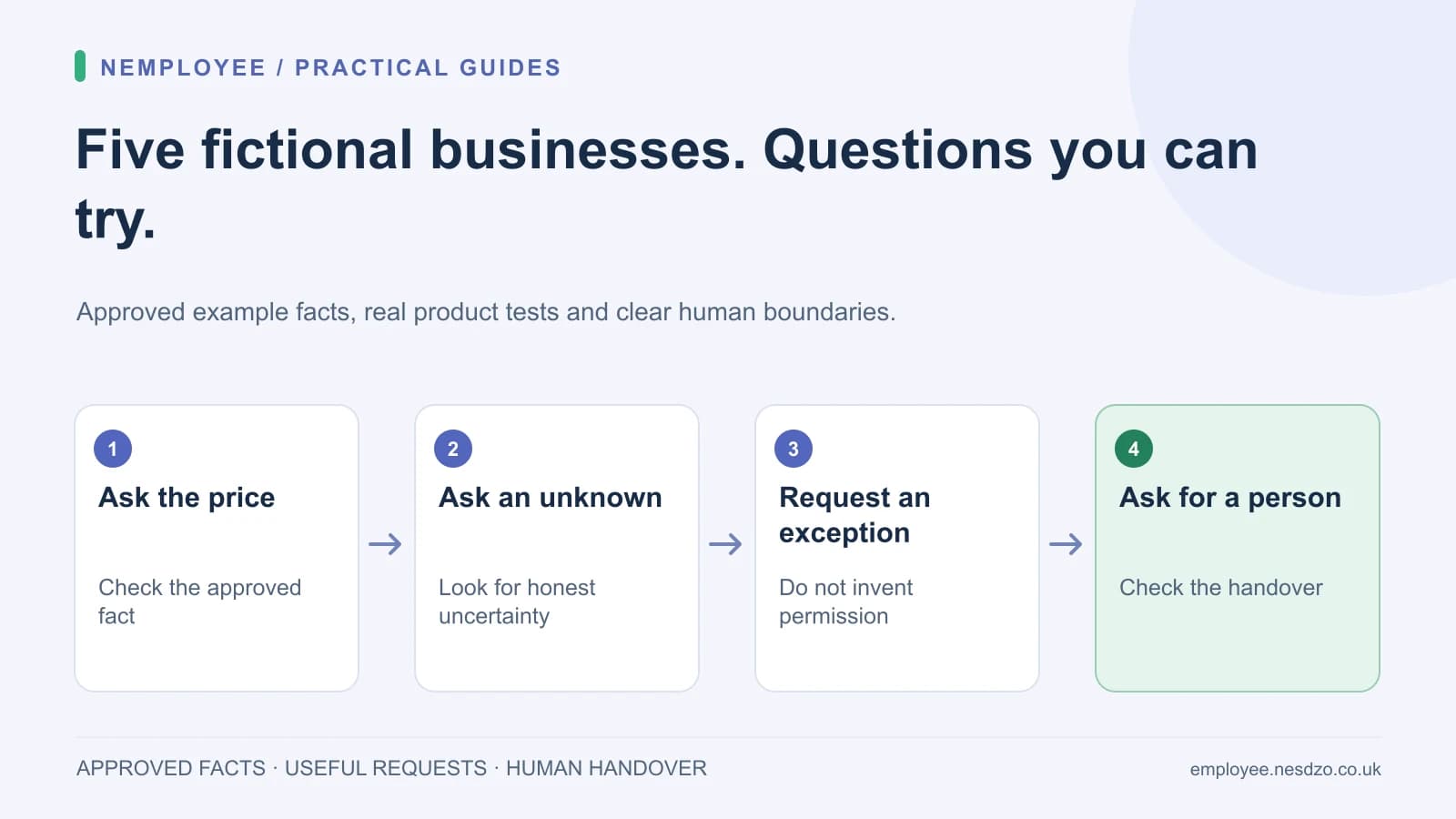
Every example allows eight replies and lasts 24 hours, subject to preview limits. Open one without entering business details, ask the approved question and use the remaining replies to test uncertainty, an exception and human handover. The public preview explains the handover capability but cannot connect you to a real employee of the fictional business.
If the workflow fits, use your website or enter approved facts to prepare your own private preview. Review the facts, test again and create a free account from that personalised demo if you want to retain the setup. Fictional sample facts are blocked from becoming a real business workspace.
Start with the documented answer, then test an unknown, an exception and a request for a person. A good example makes its limits as easy to inspect as its greeting.